


AIS vs TIS vs Form 26AS :What every Tax Payer Must Know before Filing
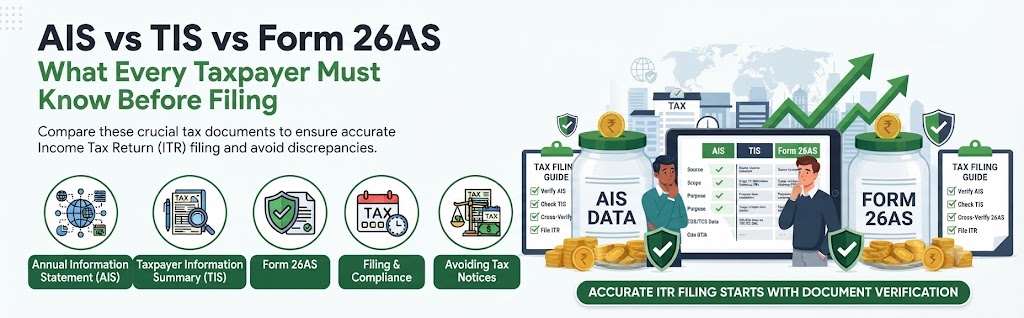
AIS vs TIS vs Form 26AS
What Every Taxpayer Must Know Before Filing
Three documents. One goal — a correct, penalty-free ITR. Here's exactly what each one tells you and how to use them smartly.
Every year, millions of taxpayers file their Income Tax Return without checking the three key documents the Income Tax Department provides. AIS, TIS, and Form 26AS together paint the complete picture of your financial and tax position — and missing even one of them can mean penalties, notices, or missed refunds. This guide breaks each document down clearly and tells you exactly how to use all three before clicking "Submit."

The Three Core Documents
What Are AIS, TIS & Form 26AS?
The Income Tax Department maintains three separate statements for every PAN holder. Each serves a distinct purpose, and together they form the most complete view of your financial and tax position for any assessment year.
AIS – Annual Information Statement: The most comprehensive document — covers income, TDS/TCS, SFT transactions, interest, dividends, and securities with full line-by-line detail. You can also submit feedback directly to correct errors.
TIS – Taxpayer Information Summary: A simplified, category-wise summary of the AIS. Shows key financial information at a glance — ideal for a quick review of taxable income before filling your ITR form.
Form 26AS (Form 168, IT Act 2025): A tax credit statement focused on TDS/TCS deducted or collected on your behalf. Essential for verifying every deductor has deposited the right amount against your PAN.
Side-by-Side Comparison
AIS vs TIS vs Form 26AS — Full Breakdown
Use the table below to understand at a glance what each document contains and how detailed each entry is.
| Feature / Parameter | AIS — Annual Information Statement | TIS — Taxpayer Information Summary | Form 26AS (Form 168) |
|---|---|---|---|
| Purpose | Comprehensive statement: income, tax, TDS, TCS, SFT, interest, dividends, securities and more | Summarised snapshot of AIS — key info in simplified, category-wise format | Tax credit statement showing TDS/TCS deducted or collected and other tax info |
| TDS / TCS Details | ✔ Detailed | ✔ Summary | ✔ Detailed |
| SFT Transactions | ✔ Detailed | ✔ Summary | ⚠ Limited only |
| Interest Income Details | ✔ Detailed | ✔ Summary | ⚠ Limited only |
| Dividend Information | ✔ Detailed | ✔ Summary | ⚠ Limited only |
| Securities Transactions | ✔ Detailed | ✔ Summary | ✘ Not Available |
| Taxpayer Feedback Facility | ✔ Available | ✘ Not Available | ✘ Not Available |
| Best Use Case | Full verification of all reported transactions and information | Quick review of key information and taxable items | Verifying TDS/TCS credits while preparing and filing ITR |

Why Review All Three Before Filing Your ITR?
Each document reveals a different angle of your tax picture. Checking all three is your best protection against notices, mismatches, and missed deductions.
✅ Verify TDS and TCS credits accurately claimed in your ITR
🔍 Cross-check interest, dividend and other income details
🏦 Identify high-value transactions reported to the Income Tax Department
⚡ Detect mismatches before you file — not after a notice arrives
🔔 Reduce chances of receiving IT notices and queries
Action Plan
5 Steps to Use These Documents Correctly
1. Download all three documents from the Income Tax e-Filing portal (incometax.gov.in). AIS & TIS are under "Annual Information Statement"; Form 26AS is under "Tax Credit Statement."
2. Start with AIS for a detailed view. Go line by line through each income category — salary, interest, dividends, securities — and flag anything that looks incorrect or unfamiliar.
3. Use the feedback facility in AIS to dispute incorrect entries before filing. Mark entries as "Information is correct," "Not fully correct," or "Relates to other PAN/year" as needed.
4. Check Form 26AS for TDS/TCS credits — ensure every employer, bank, and deductor has deposited the correct amount against your PAN. Any mismatch directly affects your refund or liability.
5. Use TIS as your final summary check before filling your ITR form. The category-wise summary makes it easy to confirm the income you're declaring matches what the department has on record.
Common Pitfalls
Mistakes Taxpayers Make — And How to Avoid Them
⚠️ Filing without checking AIS can lead to income underreporting notices — the department already knows about your bank interest, dividends, and high-value transactions from third-party reporting.
Not verifying Form 26AS means you might miss TDS credits you're entitled to — leaving refund money on the table. If there's a mismatch between your ITR and AIS/TIS, the tax department's system flags it automatically. This can trigger a scrutiny notice under Section 143(2) or a demand notice under Section 156 — both requiring written responses and potentially resulting in additional tax, interest, or penalties.
Safest approach: reconcile all three documents with your own records before filing. If you find entries you can't explain, consult a qualified CA or tax professional before submitting your return.
📋 Let BazaarX Handle Your ITR Filing
Expert CA-assisted ITR filing, tax planning, and compliance — fast, accurate, and fully online. Festive Sale: Upto 50% OFF!
Explore BazaarX
Other Services You Might Need
BazaarX is your one-stop platform for financial, tax, and compliance needs. From ITR filing to company registration, GST to MSME — all at www.bazaarx.co.
🧾 GST Registration & Returns
Get registered for GST, file monthly/quarterly returns, and stay compliant with expert support.
Explore GST Services →
🏢 Company & LLP Registration
Start your business right — Pvt Ltd, LLP, OPC, partnership deeds and more, fully online.
Register Your Business →
📑 TDS Return Filing
Accurate and timely TDS return filing for employers and businesses, with deductee corrections.
File TDS Returns →
📊 Accounting & Bookkeeping
Professional bookkeeping, financial statements, and MIS reports — keep your business audit-ready.
Get Started →
🛡️ MSME / Udyam Registration
Register as an MSME and unlock collateral-free loans, government tenders, and subsidies.
Register as MSME →
💼 Tax Planning & Advisory
Year-round tax planning from qualified CAs to help you save legally and stay compliant proactively.
Talk to a CA →
Ready to get started? Visit BazaarX for all your tax and compliance needs.
